Does Training Later in the Day Make Menopause Night Waking Worse?
Quick Answer: For most women, moderate exercise at any time of day improves sleep and does not worsen night waking. The exception is vigorous training ending within about an hour of bedtime, which can delay sleep onset. Since menopausal night waking is often driven by core temperature and vasomotor symptoms, the more useful lever is not avoiding evening exercise but allowing enough time for core temperature to fall — roughly 90 minutes — before you try to sleep.
You wake at 3am. Sometimes hot, sometimes just awake, and getting back to sleep takes an hour.
Somewhere along the way you were told not to exercise in the evening, so now the only slot that fits your life is the one you have been avoiding.
That advice is more nuanced than it is usually presented, and the nuance matters a lot when evening is the only realistic time you have.

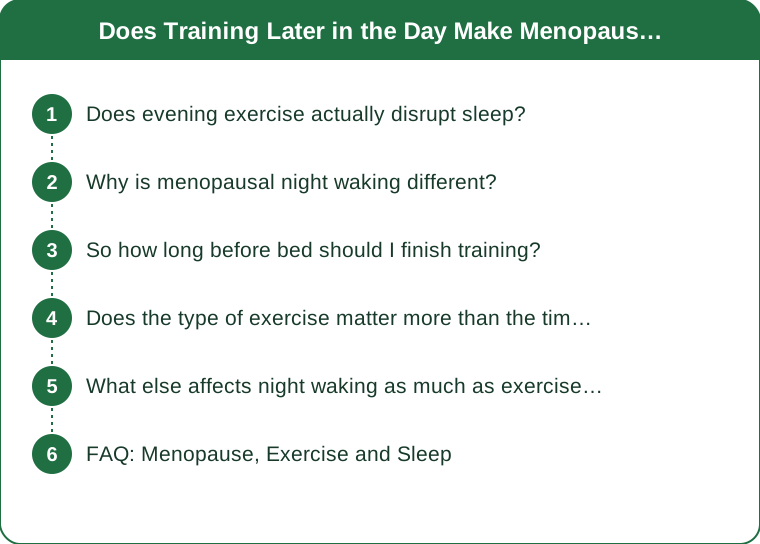
Does evening exercise actually disrupt sleep?
For most people, no — and this is one of the most commonly overstated pieces of sleep advice.
Reviews of exercise timing consistently find that evening exercise does not impair sleep quality for the majority of people, and often improves it. The general advice to avoid it comes from a real but narrow finding.
The narrow finding: vigorous exercise ending within about an hour of bedtime can delay sleep onset, because core temperature and sympathetic nervous system activity are still elevated.
Moderate exercise ending 90 minutes or more before bed appears to be fine or beneficial. So a 7pm walk, yoga class or moderate strength session is not the problem. A high-intensity interval session at 9:30pm might be.
The other thing worth naming: exercise you actually do beats optimally timed exercise you do not. If evening is your only reliable slot, that argument is over before it starts.
Why is menopausal night waking different?
Because a specific mechanism is added on top of ordinary sleep disruption.
Declining oestrogen narrows the thermoneutral zone — the range of core temperature over which your body does not need to actively heat or cool itself. A zone that was comfortably wide becomes narrow, so small rises in core temperature that previously went unnoticed now trigger a full heat-dissipation response.
That response is the night sweat, and it wakes you.
This is why menopausal night waking is often temperature-driven rather than stress-driven, and why it clusters in the second half of the night when core temperature naturally rises toward morning.
It also reframes the exercise question. The concern is not exercise itself but leaving core temperature elevated at bedtime — a much more specific and manageable problem than avoid evening workouts.
So how long before bed should I finish training?
Roughly 90 minutes is the practical target, and it is about temperature rather than the clock.
Core temperature rises during exercise and takes one to two hours to return to baseline afterward, longer for intense or long sessions. You want to be on the downslope of that curve when you try to sleep, because falling core temperature is itself one of the strongest sleep-onset signals.
That gives a useful reframe: the temperature drop after exercise can help you sleep, if you time it right. Finish too late and you are trying to sleep on the rise; finish with enough margin and you are sleeping on a steeper fall than you would have had otherwise.
A warm shower afterward is not counterproductive, despite how it sounds. Warming the skin drives blood to the surface, which accelerates core heat loss over the following 30 to 60 minutes. Finish the shower at least an hour before bed and it works in your favour.

Does the type of exercise matter more than the timing?
Quite possibly, and it is the more useful question.
Strength training has good evidence for sleep quality and is particularly relevant during menopause for bone density and lean mass. It also produces a smaller and shorter core temperature rise than sustained cardio at equivalent effort.
Moderate aerobic exercise has the strongest overall evidence for sleep improvement, though it raises core temperature more, so timing matters more.
Yoga and similar low-intensity practice show benefits for sleep and for vasomotor symptoms specifically, and have essentially no timing constraint.
High-intensity interval work is the one with a genuine evening caveat, both for temperature and for sympathetic activation.
The practical conclusion: if evening is your only slot, prefer strength work or yoga over HIIT, and keep the finish time 90 minutes clear of bed. That is a far more workable rule than avoid evening exercise.
What else affects night waking as much as exercise timing?
Several things, and one of them usually matters more.
Bedroom temperature. With a narrowed thermoneutral zone, ambient temperature does a great deal of work. 16 to 18°C is the general recommendation, and it is often more effective than any exercise change.
Alcohol. It shortens sleep onset and reliably fragments the second half of the night — the same window where menopausal waking clusters. If you are troubleshooting night waking and drinking in the evening, that is the bigger variable by some distance.
Bedding and sleepwear. Layers you can remove without waking properly, and breathable natural fibres, reduce the number of full wakings even when the flushes still occur.
Caffeine timing. The half-life is roughly five to six hours, and sensitivity often increases with age. An afternoon coffee is meaningfully present at midnight.
Evening meal size and timing. Digestion raises core temperature, so a large late meal has a similar effect to a late workout, and it is rarely considered.
FAQ: Menopause, Exercise and Sleep
Will exercise reduce hot flushes themselves, or only help me sleep?
The evidence on flush frequency is mixed — some studies find reduction, others do not. The clearer benefits are for sleep quality, mood and the cardiovascular and bone changes that accompany the transition. Treat improved sleep as the reliable outcome and flush reduction as a possible bonus.
If I wake at 3am, should I train then rather than lie there?
Not vigorously, no. Getting up briefly and doing something quiet in dim light is well supported; a workout is not, because it raises core temperature and shifts your body clock. Gentle stretching or a few minutes of slow breathing is a better fit for that window.
How long before I know whether a timing change helped?
Give it at least two to three weeks, and keep a simple log of session time, bedtime and number of wakings. Night-to-night variation is large enough that a few nights tells you nothing, and the pattern usually only becomes visible across a fortnight.
Should I see someone about this?
If night waking is persistent and affecting your daily functioning, yes. There are effective treatments including hormone therapy and CBT for insomnia, and both have good evidence in this population. This article is general information, not medical advice — a GP or menopause specialist can tell you what fits your history.
TL;DR:
- Evening exercise is fine for most people. The real caveat is narrow: vigorous training finishing within about an hour of bed.
- Aim to finish 90 minutes before bed. The falling core temperature afterward actively helps sleep onset rather than hindering it.
- Menopausal night waking is largely temperature-driven because the thermoneutral zone narrows — which is why bedroom temperature at 16 to 18°C often matters more than workout timing.
- Alcohol and late large meals are frequently the bigger variables, and both are easier to test than rearranging your week.
If evening is your only realistic training slot, keep it — prefer strength or yoga over intervals, leave a 90-minute gap, and fix the bedroom temperature first. This is general information, not medical advice; speak to a GP or menopause specialist about persistent sleep disruption.
Keep Reading
This article is for general informational and styling purposes only. Fit, sizing, and product availability may vary.