Strength Training After 45: What Actually Changes, and What Does Not
Quick Answer: The training itself barely changes — progressive overload with compound movements still works and still drives adaptation. What changes is recovery time between hard sessions, warm-up requirements, and how much attention protein and sleep need. The programming is largely the same; the surrounding infrastructure is not.
Everything written for this age group falls into two camps.
One says your body is fundamentally different now and hands you resistance bands. The other says nothing changes, train like you are 25.
Both are wrong in specific, identifiable ways. Here is the question-by-question version.

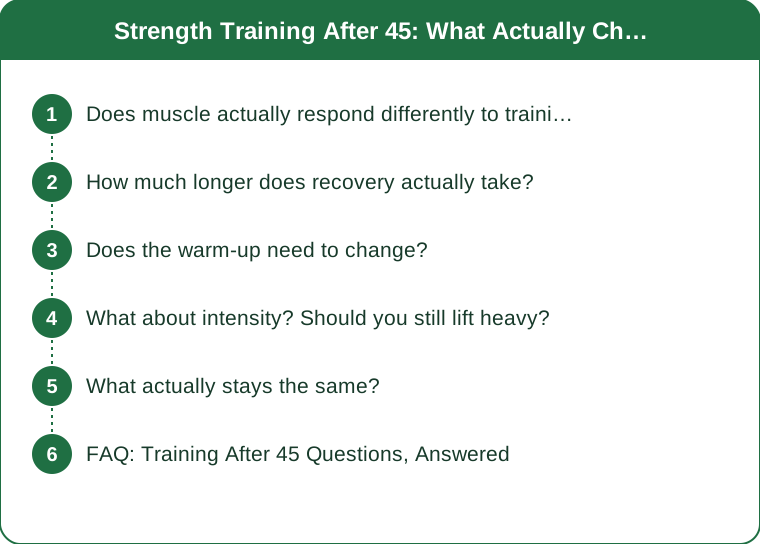
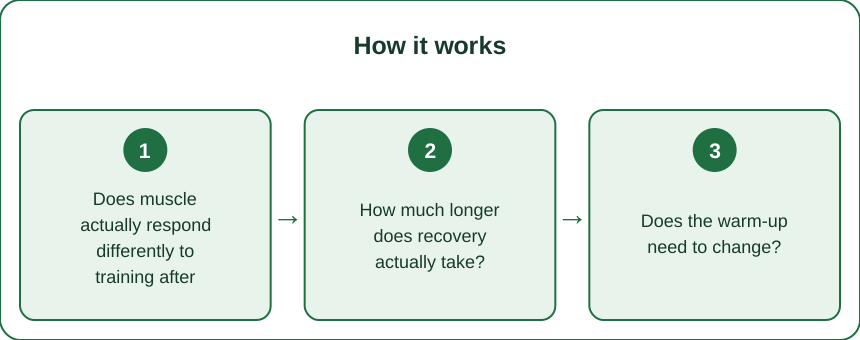
Does muscle actually respond differently to training after 45?
Less than the framing suggests. Muscle protein synthesis in response to resistance training remains robust well into later decades, and studies of previously untrained adults in their fifties, sixties, and beyond consistently show substantial strength and hypertrophy gains.
What does change is a phenomenon sometimes called anabolic resistance — the muscle-building response to a given dose of protein or training becomes somewhat blunted. The practical implication is not that training stops working; it is that the threshold dose goes up.
Higher protein intake per meal matters more after 45 than before it. The commonly cited figure of around 30 to 40 grams of high-quality protein per meal, three to four times daily, reflects this — the same total spread thinly across the day does less than it did at 25.
Training stimulus: essentially unchanged. Required nutritional support: meaningfully higher.
For women specifically, the perimenopausal drop in estrogen affects muscle and connective tissue, and there is reasonable evidence that resistance training becomes more rather than less important during this window.
How much longer does recovery actually take?
Roughly 20 to 50 percent longer between hard sessions of the same muscle group, with wide individual variation.
What this looks like in practice: if you trained legs hard every 72 hours at 30, you may need 96 hours at 50 for the same quality of session. The change is real but it is a matter of scheduling rather than of capability.
The more useful reframe is that recovery becomes the limiting variable rather than effort. Younger training is often limited by how hard you are willing to work; midlife training is limited by how quickly you can absorb the work.
This argues for a specific structural change: fewer hard sessions, more total volume distributed across them. Three properly recovered sessions a week beat five compromised ones by a considerable margin, and this is the single most common programming error in this age group.
Sleep becomes non-negotiable in a way it was not. The relationship between sleep and recovery is not new, but the margin for error shrinks.
Does the warm-up need to change?
Yes, and this is the most concrete difference of all.
Connective tissue — tendons, ligaments, fascia — becomes less compliant with age, and it warms and adapts more slowly than muscle does. A five-minute warm-up that was adequate at 25 leaves tissue underprepared at 50 even though the muscles feel ready.
A reasonable structure: 5 minutes of general cardiovascular work, then 5 minutes of movement-specific mobility for the joints involved, then ramping sets that start meaningfully lighter than you would have bothered with before. For a working set at 80 kg, that might mean sets at 20, 40, 55, and 70 rather than one set at 60.
The ramping sets are the part people skip and the part that matters most. They are not warm-up in the general sense; they are rehearsal for the specific movement pattern under progressively real load.
Budget 15 minutes. It feels like a lot until you compare it to the six weeks a strained tendon costs.
This is general information, not medical advice. Anyone with existing joint or cardiovascular conditions should consult a professional before starting or changing a strength program.

What about intensity? Should you still lift heavy?
Yes, and this is where the cautious advice does real harm.
Heavy training — sets in the 3 to 6 rep range at genuinely challenging loads — drives adaptations that lighter work does not, particularly in bone density and in the neural components of strength. Both of those matter more after 45, not less.
Bone mineral density responds to high-magnitude loading specifically. Resistance bands and light weights, whatever else they do, do not provide that stimulus. For anyone concerned about bone health in midlife, heavy compound lifting is closer to the treatment than the risk.
What changes is how you get there. Longer ramp-ups, more conservative progression, and a willingness to stop a set with one or two reps in reserve rather than grinding to failure. Training to failure produces disproportionate fatigue relative to its benefit at any age, and the imbalance worsens with recovery capacity.
A sensible weekly structure: two heavier days in the 4 to 6 rep range and one moderate day in the 8 to 12 range, all with two reps left in the tank on most sets.
What actually stays the same?
More than you would gather from most of what is written about this.
Progressive overload works identically. The requirement to gradually increase demand over time is not age-dependent and remains the primary driver of adaptation.
Compound movements remain the foundation. Squats, hinges, presses, rows, and carries are the correct backbone of a program at 25 and at 55. The loads and the ranges of motion may be individualized, but the movement categories do not change.
Consistency still beats optimization by an enormous margin. The person who trains three times a week for two years with a mediocre program outperforms the person with a perfect program who trains sporadically, at any age.
And the timeline for visible change is broadly similar — 6 to 8 weeks for noticeable strength gains, 12 to 16 for visible composition change, given adequate protein and sleep.
The training has not become a different activity. It has become an activity with less tolerance for a poor warm-up, insufficient protein, and inadequate sleep — three things that were always important and were previously survivable.
FAQ: Training After 45 Questions, Answered
Do I need to train differently during perimenopause?
The program itself, largely no. Symptom management may mean more variable session quality week to week, and building flexibility into the schedule rather than a rigid plan handles that better. Strength training also appears to help with several perimenopausal symptoms directly.
Is cardio or strength more important now?
Both, but if forced to choose, strength — because muscle mass and bone density both decline with age and cardio does not address either well. Two strength sessions plus regular walking is a better minimum than four cardio sessions.
How much protein do I actually need?
Current evidence supports around 1.6 to 2.2 grams per kilogram of body weight daily for active adults, with the higher end more relevant after 45 given anabolic resistance. Distribution matters as much as total — aim for 30 to 40 grams per meal.
TL;DR:
- Muscle still adapts well after 45; the required protein dose goes up rather than the training changing.
- Recovery between hard sessions takes 20 to 50 percent longer, so run fewer quality sessions rather than more compromised ones.
- Warm-ups need to roughly triple in length, with ramping sets doing the important work.
- Keep lifting heavy — bone density responds to high-magnitude load specifically, and light-only training does not provide it.
- Progressive overload, compound movements, and consistency are unchanged.
The honest summary is that almost nothing about the training itself needs to change and almost everything around it does. The people still lifting well at 60 are rarely the ones who found a special program — they are the ones who took the warm-up, the protein, and the sleep seriously about fifteen years earlier than they had to.
Keep Reading
This article is for general informational and styling purposes only. Fit, sizing, and product availability may vary.