Does Walking Alone Count as Real Exercise During Perimenopause? What the Research Actually Says
Quick Answer: Walking counts as real, valuable exercise during perimenopause — it supports cardiovascular health, mood, and sleep meaningfully — but research consistently shows it isn’t sufficient on its own for the two things perimenopausal bodies need most: bone density maintenance and muscle mass preservation, both of which require resistance training specifically.
Walking is the habit that survives even the roughest weeks. Whether it’s carrying the full load researchers say this decade actually needs is a different, more specific question.

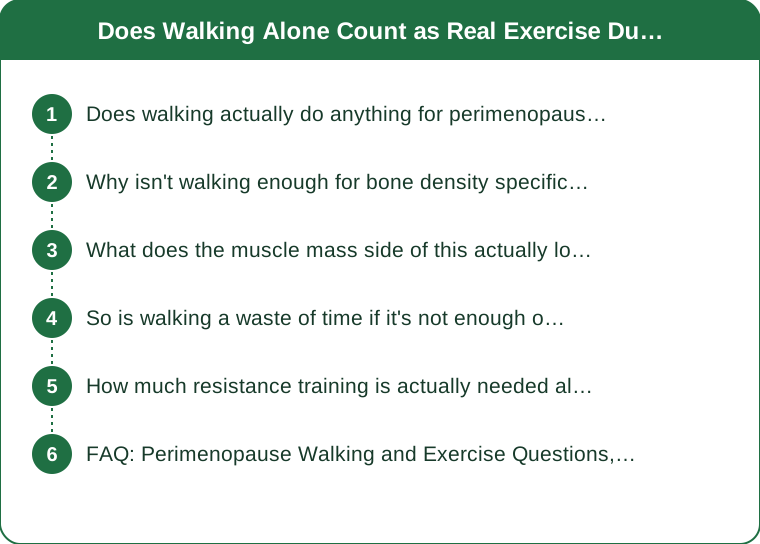
Does walking actually do anything for perimenopause symptoms specifically?
Yes, meaningfully — regular walking is associated with improved mood, better sleep quality, and reduced cardiovascular risk, all of which become more relevant during perimenopause as estrogen decline affects each of these areas. Walking is genuinely valuable exercise, not a consolation-prize activity, and dismissing it undersells real benefits that show up consistently in research on this life stage.
Why isn’t walking enough for bone density specifically?
Bone responds to mechanical stress that exceeds what it’s used to — walking, while weight-bearing, typically doesn’t provide enough load to meaningfully stimulate new bone formation once a body is already accustomed to walking as regular activity. This matters acutely during perimenopause because declining estrogen accelerates bone density loss, and research specifically points to resistance training (not just any weight-bearing activity) as the intervention shown to meaningfully slow or partially offset that loss.
What does the muscle mass side of this actually look like?
Perimenopause is associated with an accelerated rate of muscle mass loss (sarcopenia) beyond normal aging, and walking, even briskly, doesn’t provide the progressive resistance stimulus needed to build or preserve muscle tissue the way strength training does. Since muscle mass affects metabolic rate, functional strength, and fall risk later in life, this isn’t a cosmetic concern — it’s one of the more consequential physiological shifts of this decade.

So is walking a waste of time if it’s not enough on its own?
No — the research doesn’t say walking is ineffective, it says walking alone doesn’t cover every need of this life stage. The most evidence-supported approach combines walking (for cardiovascular and mental health benefits) with 2-3 sessions per week of resistance training (for bone and muscle preservation) — treating them as complementary, not competing, addresses more of what perimenopause research actually points to than either alone.
How much resistance training is actually needed alongside walking to make a real difference?
Research generally points to 2-3 sessions per week of resistance training that progressively challenges major muscle groups as the threshold associated with meaningful bone and muscle benefit — this doesn’t need to replace walking, and doesn’t require a gym membership, since bodyweight and resistance-band training can meet this threshold for many people just starting out.
FAQ: Perimenopause Walking and Exercise Questions, Answered
Is walking faster or for longer a substitute for adding resistance training?
Not really — increasing walking intensity or duration continues to build cardiovascular fitness but doesn’t provide the specific mechanical loading pattern that triggers bone and muscle adaptation the way resistance training does.
Does carrying weight while walking (like a weighted vest) close the gap with strength training?
It helps somewhat, particularly for bone loading, but it doesn’t replicate the progressive overload and full range-of-motion loading that dedicated resistance training provides for muscle preservation specifically.
Is it too late to start resistance training if perimenopause has already been underway for a while?
No — research shows meaningful bone and muscle benefit from starting resistance training at any point during or after perimenopause, though starting sooner does provide more cumulative benefit over time.
TL;DR:
- Walking provides real, meaningful benefits for mood, sleep, and cardiovascular health during perimenopause
- It doesn’t provide enough mechanical loading to meaningfully protect bone density on its own
- Muscle mass preservation specifically requires progressive resistance training, not just walking
- The evidence-backed approach combines both, not one instead of the other
Walking earns its place in a perimenopause exercise routine — the research is just clear that it needs company, not replacement, to cover what this decade actually asks of a body.
Keep Reading
This article is for general informational and styling purposes only. Fit, sizing, and product availability may vary.