How Much Recovery Time Do You Actually Need in Perimenopause?
Quick Answer: Recovery capacity does change in perimenopause - falling and fluctuating oestrogen affects muscle repair, sleep quality, and inflammation, and the research suggests women in this stage often need more recovery between hard sessions than they did a decade earlier. But the change is not uniform: it varies across the cycle and week to week, which is why a fixed schedule stops working. Train by readiness rather than by calendar. The answer is more variable, not simply more.
A fixed programme assumes a stable physiology.
Perimenopause is defined by not having one.

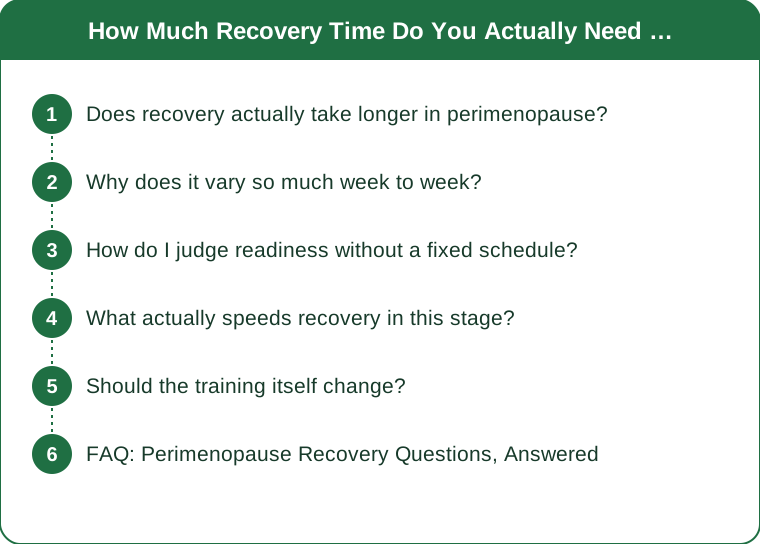
Does recovery actually take longer in perimenopause?
The evidence suggests yes, for several converging reasons.
Oestrogen plays a role in muscle repair and in limiting exercise-induced muscle damage. Research indicates oestrogen has antioxidant and membrane-stabilising properties that reduce muscle damage markers after exercise, so lower and fluctuating levels are associated with more damage and slower repair from the same session.
Sleep quality declines for many women in this stage. Night sweats, more frequent waking, and changes in sleep architecture reduce the deep sleep in which most muscle repair and growth hormone release occur. Poor sleep alone extends recovery time regardless of hormones.
Protein synthesis becomes less responsive with age. Anabolic resistance means the same protein dose produces a smaller muscle-building response than it did at 30, which affects how quickly you rebuild after a hard session.
Baseline inflammation tends to rise. The oestrogen decline is associated with a modest increase in inflammatory markers, which affects how quickly soreness resolves.
But this is not a story of decline you have to accept passively. Resistance training remains highly effective in this stage, and much of what feels like lost capacity is a recovery deficit rather than a training deficit - meaning it is addressable.
The practical translation: the same programme with more recovery often produces better results than a scaled-down programme done at the old frequency.
Why does it vary so much week to week?
Because perimenopausal hormone levels fluctuate unpredictably rather than declining smoothly.
Perimenopause is characterised by erratic hormones, not steadily falling ones. Oestrogen can spike well above premenopausal levels in some cycles and drop sharply in others, which is why symptoms and capacity vary so unpredictably.
The late luteal phase is commonly the hardest. Higher progesterone raises core body temperature slightly and can affect thermoregulation and perceived effort, and many women report that the same session feels considerably harder in that window.
Sleep varies with the cycle too. Night sweats and disrupted sleep cluster in certain phases, and a poor sleep week extends recovery independent of everything else.
Cycles themselves become irregular, so you cannot reliably predict which week you are in - which is what breaks the strategy of planning training around a cycle.
This is why a fixed 48-hour rule stops fitting. The recovery requirement genuinely moves, and a rigid schedule will sometimes be too much and sometimes too little.
The answer is a flexible framework rather than a fixed one. Plan the week’s sessions, then decide the intensity of each on the day, based on how you actually slept and how the warm-up feels.
How do I judge readiness without a fixed schedule?
Four signals, all available before you start the session.
Sleep the previous night is the strongest single indicator. A night of five hours or heavily disrupted sleep is a genuine reason to reduce load, not a reason to push harder. Sleep is when repair happens.
Resting heart rate on waking. A rise of five to seven beats above your normal baseline usually indicates incomplete recovery or accumulated stress. This takes ten seconds to check and is more objective than how you feel.
How the warm-up sets feel. The most useful test is the training itself. If your usual warm-up weight moves normally, proceed as planned. If it feels heavy, reduce the working weight by 10 to 20 percent and complete the session - this is a productive session, not a failed one.
Persistent soreness from the last session. Soreness lasting beyond 48 to 72 hours means the previous session exceeded what you recovered from, and adding another hard session on top compounds the deficit.
Set an autoregulated framework: plan three sessions, and let each one be heavy, moderate, or light based on the above. Two hard sessions and one easy one in a week beats three mediocre ones, and it beats three hard ones followed by a week off.
And track it. A single line per session - sleep hours, resting heart rate, how it felt - reveals patterns within a couple of months that no amount of guessing will.

What actually speeds recovery in this stage?
Five things, in order of how much difference they make.
Protein, and more than you think. Anabolic resistance means older muscle needs a larger dose to trigger the same response - commonly cited targets are around 1.6 to 2.2 grams per kilogram of body weight daily, distributed across meals rather than concentrated in one. Most women in this stage are eating well under this, and it is the single largest lever.
Sleep, protected deliberately. A cool bedroom, consistent timing, and limiting alcohol all measurably improve sleep quality, and alcohol in particular disrupts the deep sleep stages where repair happens. If night sweats are the barrier, that is a conversation worth having with a doctor.
Enough total food. Under-eating while training hard is common and it directly impairs recovery, and it also works against bone density, which matters increasingly in this stage.
Resistance training itself, done consistently. Strength training improves sleep quality, bone density, insulin sensitivity, and body composition in perimenopausal women - the intervention with the strongest evidence base for this stage. Recovery adjustments exist to make training sustainable, not to reduce it.
Managing total stress load, not just training load. The body does not distinguish between training stress and life stress in its recovery demands, and a high-stress period genuinely reduces training capacity.
And what makes less difference than the internet suggests: supplements, ice baths, and recovery gadgets. Creatine has reasonable evidence for muscle and possibly cognitive benefits in this population and is inexpensive; most of the rest is a distraction from protein and sleep. Discuss supplements with a doctor, particularly alongside any medication. This is general information, not medical advice.
Should the training itself change?
The structure more than the content, and less than most people assume.
Keep lifting heavy. Heavier loads with lower reps produce the strength and bone density benefits that matter most in this stage, and the common advice to switch to light weights and high reps gets it backwards. Bone responds to load.
Reduce frequency before reducing intensity. Two hard, well-recovered sessions produce more than four fatigued ones. If something has to give, it should be how often, not how hard.
Extend rest between sets. Two to three minutes between heavy sets lets you produce the quality of work that drives adaptation. Short rests turn a strength session into a conditioning session by accident.
Increase the warm-up. Tissue takes longer to prepare in midlife, and a warm-up that felt excessive at 30 is appropriate now. Ten minutes is not wasted time.
Progress in smaller increments. Smaller jumps in load, made less often, accumulate just as much over a year with far less recovery cost and far less injury risk.
And build in a deliberate lighter week roughly every fourth week. Planned deloads prevent the unplanned three-week breaks that come from pushing until something gives. This is the structural change most worth making.
One seasonal note: as daylight contracts through autumn, sleep timing and mood often shift, and training capacity commonly dips in late autumn. Expect it, plan a lighter block, and it stops feeling like a failure.
FAQ: Perimenopause Recovery Questions, Answered
Is 48 hours between strength sessions enough?
Often, but not always in this stage. Use it as a floor rather than a rule - 48 hours after a well-recovered moderate session is fine; 48 hours after a hard session on four hours of sleep frequently is not. Judge by warm-up quality.
Should I stop training during a bad symptom week?
Usually no - reduce rather than stop. A lighter session maintains the habit and often improves symptoms, while complete stops tend to extend into weeks. Move it, reduce it, or shorten it, but keep the appointment with yourself.
Do I need to train around my cycle?
It can help when cycles are regular enough to predict, and many women find the late luteal phase harder. In perimenopause, cycles are often too irregular for this to be practical - autoregulating by daily readiness works better and requires no prediction at all.
TL;DR:
- Recovery does take longer in perimenopause - oestrogen affects muscle repair, sleep quality declines, and protein response weakens.
- The requirement varies week to week, which is why a fixed 48-hour rule stops fitting.
- Judge readiness by sleep, resting heart rate, warm-up quality, and lingering soreness - then set the session’s intensity that day.
- Protein at 1.6 to 2.2 g/kg and protected sleep do more than any supplement or recovery gadget.
- Keep lifting heavy, reduce frequency before intensity, rest longer between sets, and deload every fourth week.
Write down your sleep hours and how the warm-up felt before your next three sessions. That two-line log will tell you more about your recovery than any programme can.
Keep Reading
This article is for general informational and styling purposes only. Fit, sizing, and product availability may vary.