How Should Your Training Change When the Weather Cools in Perimenopause
Quick Answer: Perimenopause narrows the temperature range in which you feel comfortable, so heat becomes a limiting factor for training in a way it was not before. Cooler weather widens that window again, which is why many women find autumn training noticeably easier. It is a genuine opportunity to raise training volume, and worth using deliberately rather than by accident.
Summer training has felt like a fight. The first cool week arrives and suddenly a session that felt brutal in July feels ordinary. That is not you being inconsistent.
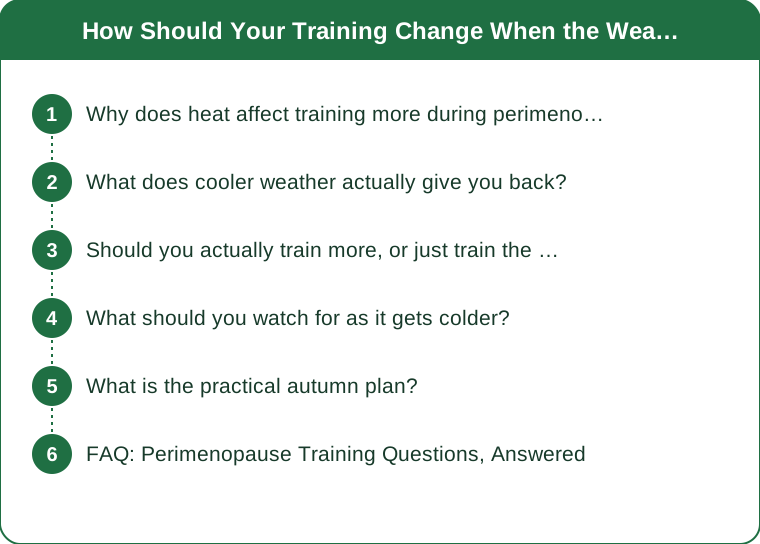
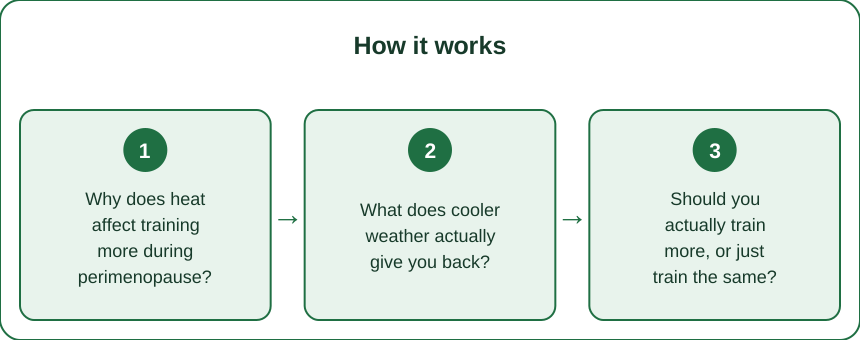
Why does heat affect training more during perimenopause?
Because the temperature range your body treats as comfortable narrows.
Declining and fluctuating estrogen affects the hypothalamus, which governs temperature regulation. The practical result is a narrower thermoneutral zone — the range of temperatures in which your body does not need to actively heat or cool itself shrinks, so smaller temperature changes trigger a response.
That is the same mechanism behind hot flashes, and it applies to exercise too. Training raises core temperature; when the comfortable window is narrow, that rise crosses the threshold sooner and triggers a stronger cooling response.
Add genuinely hot weather and you are starting closer to the threshold before the session begins. The same workout in 85 degrees and in 62 degrees is a meaningfully different physiological event when your thermoregulation is already sensitized.
This is not a fitness statement. It explains why summer sessions can feel disproportionately hard while your actual strength has not changed.
What does cooler weather actually give you back?
Several things at once, which is why the change feels dramatic.
A wider margin before overheating. You can work harder for longer before hitting the point where cooling demands take over. That shows up directly as more available training volume.
Better sleep, for most people. Cooler ambient temperature is associated with better sleep quality generally, and for anyone dealing with night sweats it can be a substantial improvement. Sleep is the foundation everything else in training sits on — recovery, appetite regulation, and the willingness to actually do the session.
Fewer sessions abandoned or shortened. Consistency improves for straightforward environmental reasons rather than motivational ones.
More outdoor options. Walking, hiking, and outdoor lifting become genuinely pleasant, which matters because variety is one of the strongest predictors of long-term adherence.
The honest framing: autumn is the easiest training season of the year for a lot of women in perimenopause, and treating it as a window to build rather than as business as usual is the practical takeaway.
Should you actually train more, or just train the same?
More, and specifically more resistance training, which is where the returns are highest at this stage.
The rationale is well established. Resistance training addresses several perimenopausal changes at once — declining lean mass, bone density, insulin sensitivity, and sleep quality all respond to it, and the evidence base is strong.
A reasonable autumn structure if summer left you doing less than you wanted:
- Three resistance sessions a week, full body, rather than two. Frequency matters more than session length for both strength and bone loading
- Progressive load. The stimulus that drives adaptation is increasing demand, and this is the variable most often left flat. Adding weight gradually is the point
- Two to three walks or easy cardio sessions, which are much more pleasant now and support recovery rather than competing with it
- One genuinely hard session a week, if you want one. Not more, because recovery capacity is the constraint
What not to do: use the improved feeling as a reason to add everything at once. The improved conditions raise your ceiling, not your recovery capacity, and a sudden jump in volume produces the same overreaching it always did.
As general information rather than medical advice: if you are dealing with significant fatigue, joint pain, or symptoms that are interfering with daily life, those are worth discussing with a doctor who takes perimenopausal symptoms seriously, rather than treating them as a training problem.
What should you watch for as it gets colder?
A few things move the other way, and they arrive later in the season.
Joints feel stiffer in the cold, and warm-ups need to be longer. This is partly a real tissue temperature effect and partly reduced ambient movement. A five-minute warm-up in July may need to be ten in November. Skipping it is the most common route to a strained session.
Thirst drops but fluid needs do not. People drink substantially less water in cool weather while still sweating during training. Dehydration in autumn and winter is more common than in summer precisely because the thirst signal is weaker.
Daylight shrinks fast, and it affects adherence. For anyone who trains before or after work, the window is closing over the next two months. Deciding now what the dark-months plan is — indoor alternative, different time, lighting — is far easier than improvising it in November.
Vitamin D intake drops with sun exposure, which is relevant to bone health and muscle function and worth raising with a doctor if you are in a northern latitude. That is a blood-test conversation rather than a guess.
Mood and energy shift for some people as light decreases, which affects training consistency independently of physical capacity. Recognizing it as a seasonal pattern rather than a personal failing is genuinely useful.
What is the practical autumn plan?
Six weeks of deliberate building while the conditions are favorable.
Weeks 1 to 2 — establish frequency. Get three resistance sessions a week happening reliably before worrying about load. Frequency is the foundation and the thing most disrupted by summer.
Weeks 3 to 4 — add load. Once the schedule is stable, start progressing weight on the main movements. Small increments, consistently, beats large jumps.
Weeks 5 to 6 — consolidate. Hold the new volume and load, and see how recovery holds up. If sleep and energy are fine, this becomes your new baseline going into winter.
Throughout: protein at 30 to 40 grams per meal, which matters more with age because the muscle-building response to protein becomes blunted. Sleep protected as seriously as the training. Walking as the background activity that supports everything else.
And track something objective. Weight on the bar, reps at a given weight, or how a given session felt on a 1 to 10 scale. Perimenopausal training is full of week-to-week variability, and a record is the only way to distinguish a bad week from an actual trend. Judging progress by how you feel on any single day is close to useless when the underlying hormonal picture is fluctuating.
The goal for the autumn is not a transformation. It is arriving at January with more lean mass, a stable three-day-a-week habit, and a training plan that survives the dark months — which is a considerably better position than most people are in by then.
FAQ: Perimenopause Training Questions, Answered
Why did summer feel so much harder if my fitness has not changed?
Because the thermoneutral zone narrows during perimenopause, so heat becomes a limiting factor earlier and more strongly than it used to. Your capacity was intact; the environment was consuming more of it. That is why the same session feels ordinary again in cooler weather.
Should I lift heavier or do more reps at this stage?
Both have a place, and heavier loading has specific advantages for bone density, which is a priority in this period. A practical approach is to keep most work in a moderate range and include some genuinely heavy sets on the main lifts, progressed carefully. If you are new to heavy lifting, working with a coach for the first few months is worth it for technique alone.
How much does sleep actually affect this?
A great deal. Sleep affects muscle protein synthesis, appetite regulation, recovery, and your willingness to train at all. Cooler autumn nights often improve it noticeably for women dealing with night sweats, which is part of why the season feels easier. If sleep disruption is severe or persistent, that is a legitimate medical conversation rather than something to manage with training alone.
TL;DR:
- Perimenopause narrows your comfortable temperature range, so heat limits training more than it used to
- Cooler weather widens that window again, which is why autumn sessions feel ordinary after a brutal summer
- Use the window deliberately: three full-body resistance sessions a week, progressive load, protein at 30 to 40 grams per meal
- Watch for longer warm-ups needed, lower thirst despite the same fluid needs, and the shrinking daylight window
The summer was harder for a physiological reason rather than a motivational one, and autumn genuinely gives capacity back. Building deliberately over the next six weeks is what makes the difference by January.
Keep Reading
This article is for general informational and styling purposes only. Fit, sizing, and product availability may vary.