Joint-Friendly Cardio for Your 40s, 50s and Beyond
Quick Answer: Cycling, swimming, incline walking, elliptical, and rowing all deliver real cardiovascular work with a fraction of running’s impact. Aim for 150 minutes of moderate activity a week across two or three of them, and add two short strength sessions — because after 40, losing muscle is a bigger threat to your joints than cardio is.
At some point your knees start filing formal complaints about activities your heart still very much enjoys.
The usual response is to quit — running goes, then classes, then most things — and the fitness quietly goes with it. That’s the wrong trade. The answer isn’t less cardio; it’s cardio that respects your joints while still genuinely challenging your engine.
Here’s the menu, and it’s a better menu than most people expect.

Why does impact hit harder after 40?
Because recovery gets slower, not because your joints get fragile.
Cartilage has no blood supply and repairs slowly at the best of times. Tendons and ligaments lose some elasticity with each decade. None of that means impact is dangerous — moderate loading is actually good for joints and bone. It means the accumulation matters more: what your body absorbed in 24 hours at 25 might take 48–72 hours at 50.
So the strategy isn’t elimination. It’s distribution — spreading work across activities that load your joints differently, so nothing takes a daily pounding.
Worth saying plainly: inactivity is far worse for joints than exercise is. Cartilage relies on movement for nutrient exchange, and the muscles around a joint are its shock absorbers. Doing nothing is the one strategy guaranteed to make things worse.
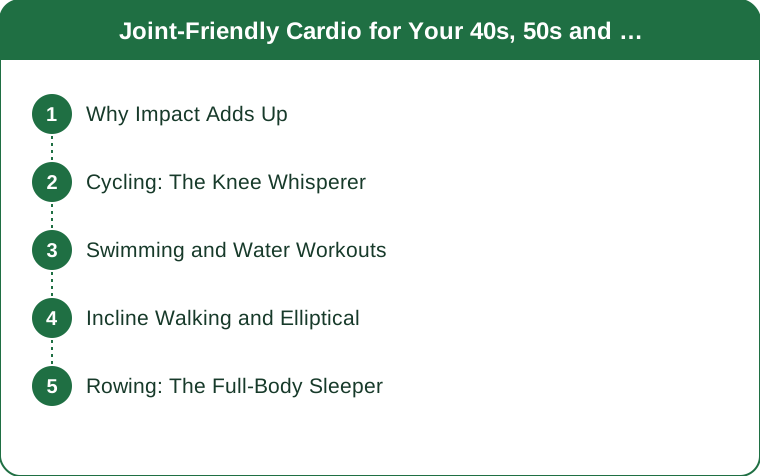
Cycling: the knee whisperer
Stationary or outdoor, cycling produces almost no impact while loading the quads, glutes, and calves properly, and intensity scales infinitely — from an easy spin to intervals that will genuinely humble you.
The one thing that matters: saddle height. Too low is the source of nearly every cycling knee complaint. With the pedal at its lowest point, your knee should retain a slight bend of about 25–30 degrees, not lock straight and not stay noticeably bent. Ten minutes of adjustment fixes most problems.
Cadence matters too. Spinning at 80–90 rpm in a lighter gear is far kinder to knees than grinding at 60 rpm in a heavy one. Many ex-runners find their second sport here.

Swimming and water workouts
Water removes most of gravity while resisting every direction you move. Chest-deep water reduces effective body weight by roughly 70%, which is why the pool is the most underrated gym in midlife.
- Swimming is full-body, zero-impact, and excellent cardio. The caveat is shoulders — freestyle volume can aggravate an existing shoulder issue, so rotate strokes.
- Aqua jogging with a flotation belt in deep water replicates the running motion with no landing at all. It’s what injured elite runners use to maintain fitness, and it’s genuinely hard work.
- Water aerobics gets unfairly dismissed. A proper class holds a moderate heart rate for 45 minutes with zero joint stress.
If your joints are actively sore, water is where to go. It’s the only environment where you can work hard while a painful joint is essentially unloaded.
Incline walking, elliptical, and rowing
Incline walking is the most underrated option on this list. A treadmill at 8–12% incline gets most people to a jogging-equivalent heart rate with no impact spike at all — you’re walking, just uphill. Don’t hold the handrails; it drops the effort substantially and wrecks your posture. Hills are honest work.
The elliptical mimics the running motion with your feet never leaving the pedals. Use the arm handles for full-body work, and vary resistance rather than just going faster.
Rowing is the sleeper. It works about 80% of your muscle mass, spikes heart rate fast, and treats joints kindly — if your form is sound. The sequence is legs, then back, then arms, and reverse on the return: arms, back, legs. Get that wrong and you row with your lower back, which is how people hurt themselves. Get it right and ten minutes converts most skeptics.
What Nobody Tells You
Strength training matters more than the cardio choice. Muscle mass declines roughly 3–8% per decade after 30, and accelerates after 50. Since the muscles around a joint are its shock absorbers, losing them is a bigger long-term threat to your knees than any cardio you’d pick. Two 30-minute sessions a week — squats, hinges, rows, presses, at whatever load is challenging for 8–12 reps — protects joints better than avoiding impact does.
Some impact is good for bone. Bone density responds to loading, and completely eliminating impact means losing that stimulus. Unless a professional has told you otherwise, keep some walking, stair climbing, or light hopping in the mix.
Warm up properly now. Five to ten minutes of easy movement before anything intense stops being optional somewhere in your 40s. Joints need the synovial fluid circulating first.
Comfortable kit removes a barrier. High waist yoga pants that stay put through a rowing stroke or a cycling class means one less reason to skip. Sounds trivial; isn’t.
When to see a professional: joint pain that persists more than a week, swelling, locking, giving way, or pain that wakes you at night all warrant a doctor or physio rather than a workaround. Modifying around genuine joint damage without a diagnosis is how small problems become large ones. This is general guidance, not medical advice.
FAQ
What is the best low-impact cardio for bad knees?
Cycling and swimming are the two most reliable, because both remove impact almost entirely while still allowing high intensity. Incline walking is an excellent third option if your knees tolerate walking — the incline raises effort without raising impact. Start with 20 minutes and build gradually.
How much cardio should I do in my 50s?
Around 150 minutes of moderate activity per week, or 75 minutes of vigorous, is the standard guideline — roughly 30 minutes on five days. Splitting that across two or three different activities distributes the load and reduces overuse risk compared with doing the same thing daily.
Is walking enough exercise after 50?
Walking covers cardiovascular health well, especially at a brisk pace or on hills. What it doesn’t cover is strength and bone density, which decline meaningfully with age. Walking plus two short resistance sessions a week is a genuinely complete program; walking alone leaves the biggest gap unaddressed.
TL;DR:
- Impact isn’t the enemy; accumulation is. Distribute work across activities rather than eliminating it.
- Cycling (check saddle height), swimming and aqua jogging, incline walking at 8–12%, elliptical, and rowing all deliver real cardio with low impact.
- Target ~150 moderate minutes a week across two or three modes.
- Add two 30-minute strength sessions — muscle loss threatens joints more than cardio does.
- Keep some impact for bone density unless told otherwise, and warm up for 5–10 minutes.
- Persistent pain, swelling, or locking means see a professional, not find a workaround.
Keep Reading
This article is for general informational and styling purposes only. Fit, sizing, and product availability may vary.