What Actually Changes About Recovery Time After 45
Quick Answer: Recovery after 45 changes less in maximum capacity and more in how long full recovery takes and how sensitive it is to sleep, protein, and stress. Muscle protein synthesis responds to a smaller stimulus less readily, sleep quality often declines, and hormonal changes affect tissue repair. The result is not that you can train less — it is that the same weekly volume needs to be arranged differently, with more spacing between hard sessions of the same type and considerably more attention to what happens between them.
Here are the specific questions, answered.

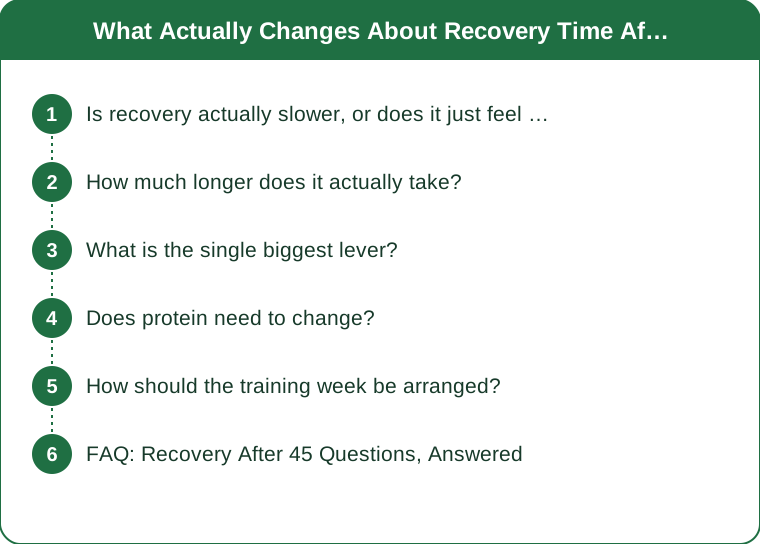
Is recovery actually slower, or does it just feel that way?
Both, and separating them matters because they have different solutions.
There is a genuine physiological component. Muscle protein synthesis becomes less responsive with age, a phenomenon often described as anabolic resistance. The same dose of protein and the same training stimulus produce a smaller synthetic response than they did at 25. That is real and measurable.
Inflammatory resolution also slows somewhat, meaning the low-grade inflammation from a hard session takes longer to clear.
And for women specifically, the perimenopausal decline in estrogen affects muscle and connective tissue repair, along with sleep quality — which is itself one of the largest determinants of recovery.
The perception component is real too. Life at 45 typically involves more sleep disruption, more stress, more competing demands, and less flexibility to nap or rest. Recovery is not only a physiological process; it is also a time and circumstance process, and the circumstances get harder.
Which is genuinely good news, because the second category is more controllable than the first. Most people over 45 who feel recovery has collapsed are dealing with a sleep and protein problem layered on top of a modest physiological change, and the layer on top is the bigger contributor.
How much longer does it actually take?
Less than the fear and more than the ideal, and it varies enormously by session type.
The research on age and recovery generally shows longer time to full force restoration after hard eccentric or high-volume work, with the differences most pronounced after unaccustomed exercise.
What that translates to practically:
Heavy strength work on the same muscle group may need a longer gap than the 48 hours often recommended. Many people over 45 find 72 hours between hard sessions for the same pattern works considerably better.
Easy aerobic work needs no additional recovery and often accelerates it. This is unchanged.
High-intensity intervals are where the difference shows most. Two hard interval sessions in a week is manageable for most; three is where people over 45 commonly break down, whereas a younger athlete might absorb it.
Unaccustomed movements require the most caution. The soreness from a genuinely new exercise is more pronounced and longer lasting. Introduce new movements at low volume.
The critical point: weekly volume does not need to fall. The arrangement changes. Four sessions spread with more space between similar demands beats four sessions clustered, even though the total is identical.
What is the single biggest lever?
Sleep, by a wide margin, and it is also the thing most disrupted in this age group.
Muscle repair, growth hormone release, and inflammatory resolution are all concentrated in sleep, particularly the slow-wave sleep in the first half of the night. Short or fragmented sleep degrades recovery more than any training variable you could adjust.
The difficulty is that sleep is commonly disrupted in perimenopause and midlife — night sweats, more frequent waking, earlier waking, and a general reduction in deep sleep.
What helps, in order of evidence and practicality:
A consistent bedtime, more than a consistent wake time. Most people already have a fixed wake time. The variable end is bedtime, and it determines total duration.
A genuinely cool room. Core temperature has to drop to initiate and maintain sleep, and this is doubly relevant if you experience night sweats. This gets easier over the next several weeks as nights cool — many women find sleep improves markedly in autumn for exactly this reason.
Moving hard sessions earlier where possible. Evening high-intensity work raises core temperature and sympathetic activity, and the effect on sleep onset is larger in midlife.
Limiting alcohol, particularly on training days. It reduces slow-wave sleep specifically, which is the portion doing the recovery work.
This is general information, not medical advice. Persistent sleep disruption, particularly with night sweats or mood changes, is worth discussing with a doctor — there are treatment options and this is a legitimate medical conversation rather than something to endure.

Does protein need to change?
Yes, and this is the most actionable nutritional change in this age group.
Because of anabolic resistance, the amount of protein needed to maximally stimulate muscle protein synthesis in a single meal is higher after middle age than it is in young adults. The same 20 grams that produces a strong response at 25 produces a weaker one at 50.
Two practical adjustments follow.
Raise the per-meal dose. Rather than spreading protein thinly, aim for a substantial amount in each main meal — commonly cited targets sit in the range of 30 to 40 grams per meal for this population, with total daily intake around 1.2 to 1.6 grams per kilogram of body weight for people training regularly.
Distribute it across the day. Three or four meals each containing a meaningful dose beats a small breakfast, a small lunch, and a large dinner. Most people are heavily back-loaded and the morning is where the gap is.
Include some in the evening. A protein-containing meal or snack before bed supports overnight muscle protein synthesis, which is when much of the repair happens.
The quality point matters too: leucine content drives the response, and it is highest in dairy, eggs, meat, fish, and soy. Plant-based eaters can absolutely meet the requirement and generally need somewhat higher total intake and more attention to variety.
This is general information, not individual dietary advice. Anyone with kidney disease or other relevant conditions should discuss protein targets with a doctor.
How should the training week be arranged?
With deliberate spacing rather than reduced volume, and with the hard days genuinely hard.
A structure that works well for many people over 45:
Two to three strength sessions per week, spaced. Full body or upper/lower splits with at least 48 to 72 hours between sessions loading the same pattern heavily.
Keep the easy days genuinely easy. The most common mistake is moderate-intensity everything, which accumulates fatigue without producing much adaptation. A walk should be a walk.
Limit high-intensity sessions to one or two per week. More than that is where most breakdowns happen in this population.
Add one full rest day, treated as part of the program rather than a failure.
Build in a lighter week every four to six weeks. Reduce volume by roughly a third and keep intensity. Younger athletes can often skip deloads; over 45 they earn their place.
Two more points that matter more than they used to.
Warm up properly. The gap between cold and warm performance widens with age, and connective tissue tolerates a rushed start less well. Ten minutes is a reasonable investment. This becomes more relevant as mornings cool over the coming weeks — a warm-up calibrated for August is short for October.
Watch for the pattern rather than the day. One bad session means little. Three weeks of declining performance, poor sleep, and low motivation is meaningful and usually means the arrangement needs adjusting, not that you need to push harder.
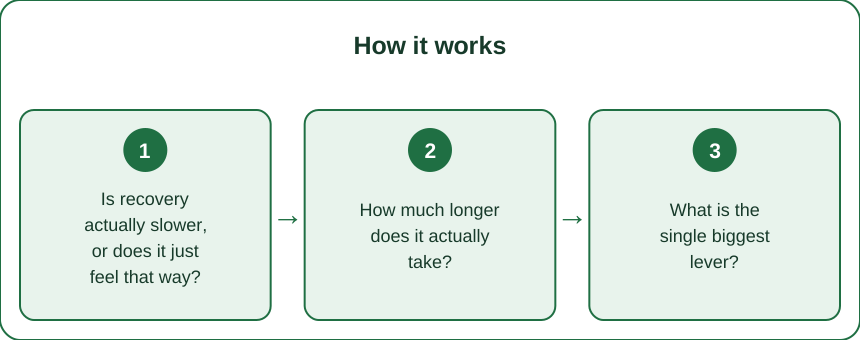
FAQ: Recovery After 45 Questions, Answered
Should I train less often?
Usually not. Frequency is valuable, particularly for strength maintenance. What changes is how hard sessions are distributed and how genuinely easy the easy days are. Same number of sessions, different arrangement.
Why am I sore for four days now when it used to be two?
Delayed onset soreness after unaccustomed or eccentric work lasts longer with age, and it is a poor guide to recovery status. If you can produce normal force and move well, you are more recovered than the soreness suggests.
Do supplements help?
Creatine has good evidence for strength and lean mass in this age group and is inexpensive and well studied. Protein supplementation helps if you struggle to hit the target through food. Most other recovery supplements have thin evidence. This is worth discussing with a doctor if you take medication.
Is it too late to build muscle?
No. Studies of resistance training in older adults consistently show meaningful gains in strength and muscle mass. The rate is slower and the direction is the same, and the health returns are arguably larger than they were at 25.
TL;DR:
- Recovery capacity changes modestly; sensitivity to sleep, protein, and stress changes a lot — and that second part is controllable.
- Weekly volume does not need to drop. Spacing between hard sessions of the same type does need to increase, often to 72 hours.
- Sleep is the single biggest lever: consistent bedtime, cool room, hard sessions earlier, less alcohol on training days.
- Raise per-meal protein rather than total alone, distribute it across the day, and include some in the evening.
- Keep easy days easy, cap high-intensity sessions at one or two weekly, and take a lighter week every four to six.
Pick the one of these that is furthest from where you are and change only that for a month. It is usually sleep, and it is usually the fastest result.
Keep Reading
This article is for general informational and styling purposes only. Fit, sizing, and product availability may vary.